

WATCHING THE DISASTER MOVIE
(Someone had to go boldly first…)

There’s a truism that it’s easier to learn from someone’s failure than another’s success.
Great works of art resist critical traction. Analysis slides down the glistening perfection of the masterpiece.
It is failures that give us a foothold to ponder the attempts that went off the rails.
No one sets out to make a bad movie. (Pace, Springtime for Hitler), But some attempts are so zany they do make you wonder.
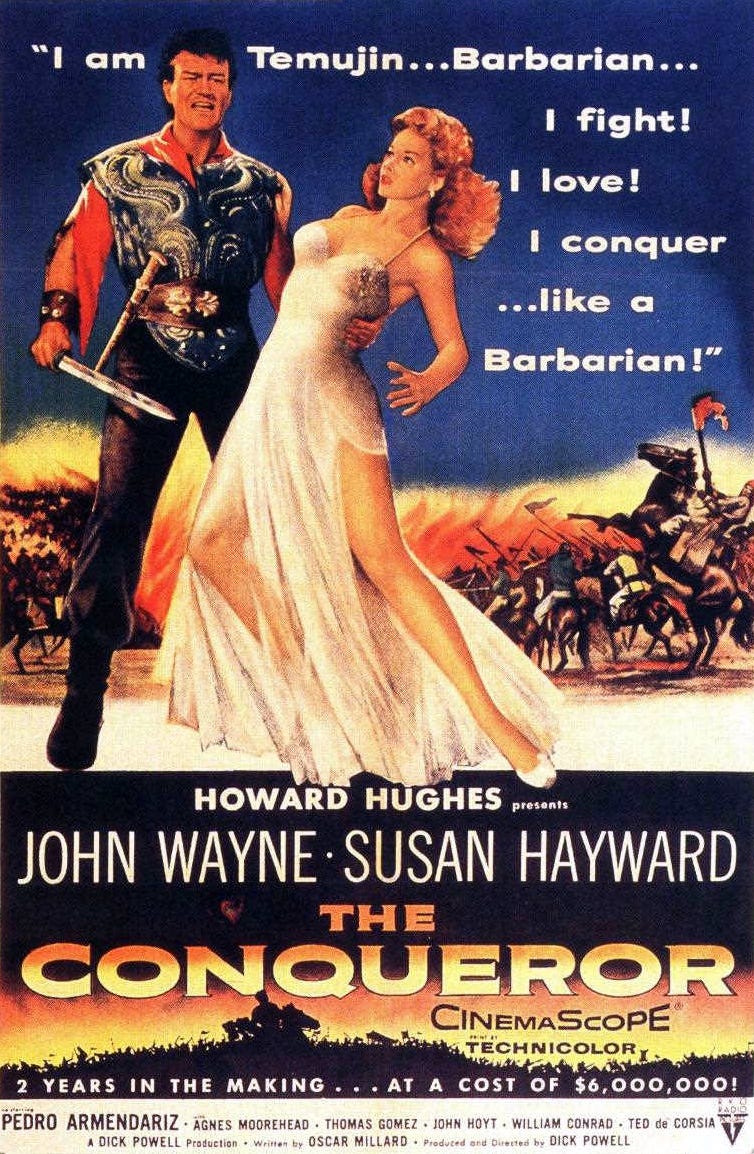
All my life I’ve heard stories of the Howard Hughes-produced RKO epic, The Conqueror, (1956) starring John Wayne as Genghis Khan.
That’s what I said. Starring John Wayne and directed by – of all people – Dick Powell (up - or maybe DOWN - from his high-pitched tenor roles in those Busby Berkley movies and after his sturdy portrayals of Chandler’s Phillip Marlowe in the ‘40’s).
The Conqueror was shot in St. George, Utah, doubling for Mongolia’s Gobi Desert.
The people who made the film were not unintelligent. They had a clear and specific notion of the story they wished to tell.
The movie is mostly infamous for the number of participants who died of cancer, allegedly the result of exposure to radioactive fallout from filming downwind of the nuclear bomb test sites in nearby St. George. It has never been satisfactorily proved that these deaths were statistical anomalies; there were many heavy drinkers and smokers among cast and crew, so maybe many of these folks were ill-fated anyway.
But what of the film itself, which I had never seen? It turns out you can stream it, and the other night I did just that.
Some free associations follow…
Historian Barbara Tuchman, in her book, The March of Folly, chronicled the history of bad ideas that somehow took hold and the resultant disasters that ensued. She began with the Trojans’ idiotic decision to bring the Greeks’ wooden horse within their otherwise impregnable walls.
Other bad decisions included Japan’s decision to attack Pearl Harbor in the mistaken belief that an island could defeat a continent – a notion that Tom Paine ridiculed as early as the American Revolution, where Great Britain learned the same elementary lesson two hundred years earlier.
Another pointless folly: Hitler invading Russia, with the example of Napoleon’s failure to do the same thing before him.
(The thing about Russia – it never ends…)
Or America’s decision to insert itself – and 55,000 American lives – into Vietnam, following the disastrous French attempt to do the same.
What about Coca Cola deciding to eliminate basic Coke? Who thought that up???
I suppose the notion of getting John Wayne to play Genghis Khan doesn’t exactly compare with the foregoing, but the fact that the Duke was somehow persuaded to portray a Mongol warrior and forsake his own familiar turf (the mythic American west), and the short, almost Pinterqesue dialogue at which he excelled, (“that’s a fine lookin’ horse you got there”), in favor of stilted, flowery, “old timey” speech, must be counted as among the most bone-headed ideas that prompted the expenditure of millions. (And that’s not counting the horses and men you have to believe were injured during many of the film’s “stunts”.)
What were they thinking? How did John Wayne, a 40 karat movie star who understood what he was good at, decide to play a Mongol chieftain?
It turns out Wayne didn’t need persuading. Turns out it was his idea. Having read the script and recognizing similarities between westerns and this particular “Eastern,” Wayne was determined to play Genghis Khan and, as director Powell noted, “You don’t turn down John Wayne.”
Even without the possibility, if not the inevitability, of radiation poisoning, (Wayne posed on set with a Geiger counter!) filming in 120 heat was a nightmare for cast, crew and animals.
But they doggedly persevered.
You will not be surprised to learn there is a great deal of racist, cultural stereotyping, and aside from some spectacular action sequences with (many, MANY horses and men injured), the film doesn’t work. We don’t believe John Wayne as Genghis Khan – (“I want the Tartar Woman. I feel it in my blood,” and other lines of that ilk don’t help) –
So what, if anything, is the takeaway from The Conqueror? As I’ve noted elsewhere, movies are like souffles; they either rise of they don’t. Films with perfect pedigrees lie flatter than pancakes. While movies that seem doomed from the start somehow morph as megahits. (Babe, anyone?)
Could John Wayne have ever worked as Genghis Khan?
And do we, ought we, to condemn folks like Wayne, an artist (yes!) who decide to take a chance, to stretch themselves, to try something different? The definition of hack, (routinier is the French word), is someone who finds something they’re good at and just keeps doing it.
I would know.
Wayne and company, went out to Utah and took chances, with their reputations and their lives.
The Conqueror doesn’t work and it’s easy to ridicule, but it turns out that after I laugh at the awfulness, other thoughts creep in.
By today’s lights, a film about Mongols should at least have an Asiatic cast, not a blue-eyed, pidgin-talking, John Wayne, John Hoyt and Thomas Gomez et al.
But even such a masterpiece as Lawrence of Arabia (1963) boasts superb performances by Alex Guinness and Anthony Quinn as Arabs - but with the additional casting of Egyptian Omar Shariff as Sherif Ali, you can see the cultural sensibility has begun to turn. In the ‘30’s, a Swede like Warner Oland might mask up as Charlie Chan, but by the time David Lean made A Passage to India, (1984) Alec Guinness as Indian Professor Godbole, was unacceptable.
Following this digression for a moment, can only black actors nowadays play Othello? When Shakespeare wrote the play, how many black actors were living and working in England?
Surely the whole idea of acting is the art of pretending to be someone else.
Is a white actor pretending to be black – or Mongol – the same as performing in a minstrel show?
I think we can fault John Wayne’s performance as Genghis Khan, but I’m not sure we can fault him for trying.
Barbara Tuchman’s book, The March of Folly, implicitly questions whether humans can learn from their mistakes.
But you have to make mistakes before you can learn from them.
Pax, John Wayne.
As for the multi-talented Dick Powell, take a look at his directorial masterpiece, made only one year later, The Enemy Below, (with Robert Mitchum and Curt Jurgens) to see he was first rate director.
Let us not speak disrespectfully of failure. Or artists who try not to play it safe.
How do we feel about artists who take chances?
So interesting at the bottom of the movie poster that they cited and boasted about the production cost?!
If Marion Morrison wanted to stretch himself he could have played Joe McCarthy or some other non-hero role. But he, like many actors, was acutely conscious of his image and surely wanted this role because he mistakenly felt he had the chops to enhance that image. He fell victim, not to taking an artistic risk and falling short, but rather to hubris.