

UNDER THE INFLUENCE (II)
The Immortal, Immoral Gypsy

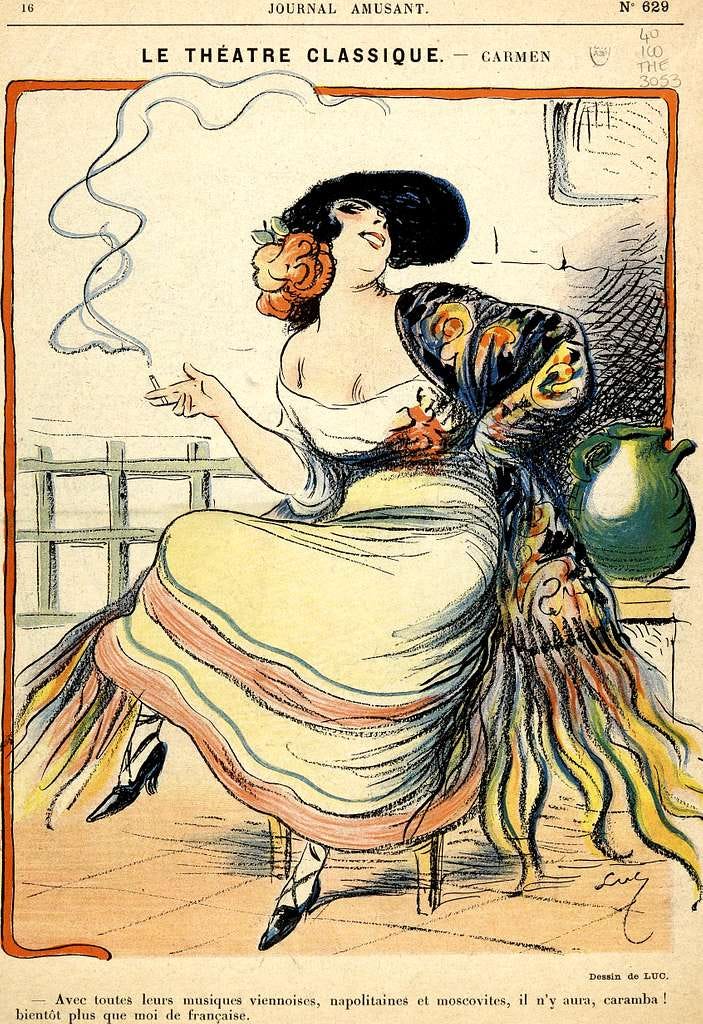
As I’ve said, influences seem to arrive in two forms: those one is unaware of having absorbed, and those that smack you in the face with the force of revelation.
An example of the latter was my viewing of the Olivier film of Shakespeare’s Henry V at age 13. I understood as I was watching the movie that my life would never be the same. I may not have grasped how my world was about to change, but I intuitively understood that it was going to.
But I can point to an even earlier instance of an experience that I dimly understood was life-changing even as I experienced it.
Both my parents were accomplished musicians — my mother a concert pianist, and my father, the shrink, was also an excellent pianist. I was intensely musical from infancy, listening to my mother practice for hours every day or play four-hand duets with my father. I discovered Mozart, Scarlatti, Beethoven and Chopin in my crib. So-called classical music was my first language and remains my chief musical love.
This by way of preamble.
I was five years old and trudging upstairs to bed as usual when my father, prompted by whatever impulse drives someone to yen for a certain piece of music at a certain moment, put on his recording of Bizet’s Carmen.
I remember what happened next as vividly as if it were five minutes ago instead of seventy-five years. From the first orgasmic notes of the overture — still the most exciting sounds I have ever heard — I was drawn downstairs as if by a magnet. Carmen became and thereafter remains my north star, and Bizet — poor, short-lived Georges Bizet — the artist with whom I most identify. Not in terms of talent, god knows, but in terms of sensibility, definitely. Bizet was exuberant on the outside (hear those crashing, opening notes), and black as pitch within — just listen to the fate motif that follows right behind the ecstatic opening with its doom-laden aftermath. That combo is me, no question. I like to think I project humor, warmth, exuberance, and energy. But the rest of me — the sunken part of the iceberg — I sense is dark as death. Carmen herself encapsulates both extremes, life-affirming sensuality coexisting with knowing fatalism.
Did my five-year-old self understand any of this? Of course not. At the time I was merely captivated by the sheer sensation of the music, the overture followed by a succession of hit tunes that tease the ear the way every line in Hamlet (or Casablanca, for that matter) now comes across as a string of quotations. Starting with the Toreador Song, the biggest hit in all opera — now derided as a cliché (Bizet’s comment: “Oh, well, the public want shit — there it is”) — the tune is a warm-up for every other hummable song in Carmen. All of them hits. And lest the word opera create unease, the reality is that Carmen, as originally written, was conceived as a musical. That is to say that the songs were interspersed with spoken dialogue, which explained and contrasted with the sung parts.
Incidentally, there’s no such thing as a toreador. Bizet made up the word because his song required four syllables. Having only three syllables, matador or torero wouldn’t cut the mustard. (Try humming the song with only three syllables if you don’t believe me.)
Then there’s Carmen’s entrance, the “Habanera,” a kind of tango everyone recognizes when they hear it hummed. It’s been disco-ed to death.
Three months after the opera’s scandalous premiere in 1875 (women smoking! On stage! Sex! Guys trying to knife each other!) Bizet died of an aneurysm, aged thirty-six, never knowing he’d created the most durable hit in the repertoire. And in the wake of his death — one might say over his dead body — other hands went to work, replacing passages of spoken dialogue with sung recitatives linking the songs, and in the process eliminating Bizet’s carefully worked-out scheme of contrasting and exploiting the difference between what was spoken and what was sung. Example: when Carmen, under arrest, is told No talking! by arresting officer Don Jose, she begins to sing. When Jose reiterates No talking!, she responds, “But I’m not talking. I’m singing. There’s no law against singing” — and proceeds to seduce the hapless corporal with the oh-so-seductive “Seguidilla.”
But if Jose and Carmen are singing already, the distinction between talk and song is lost.
The more spoken dialogue is allowed into the production, the richer and more complex the opera becomes. In the all-sung version, Don Jose emerges as simply a mama’s boy, devoted to his virginal girlfriend, but in Bizet’s original, we learn Jose joined the army because he killed a man. Jose is thus no goody-two-shoes about to be waylaid by a vicious if attractive Gypsy. In the original, these two deserve each other.
Shortly after my discovery of Carmen, my parents took me to see the actual opera. By then I knew all the music by heart and hid under my seat in Act IV so I wouldn’t see Carmen get killed. La belle dame sans merci, who finally receives none herself, knifed by her hapless, jilted boyfriend, fascinates and arouses to this day. It sure shocked original audiences. The thrilling combo of exhilaration and fatalism, of love and death, I think represents me quite well. And self-evidently I am not alone. Generations have been hypnotized by what we might call Carmen and José’s fatal attraction.
Over the years I’ve collected just about every recording of Carmen, most polluted with those icky inserted recitatives, and regrettably few in line with Bizet’s original conception, a play with songs. And I’ve pondered over a lifetime the peculiar alchemy that makes Carmen the masterpiece it is. How did Carmen come into being anyway? What elements led to this shattering musico-dramatic experience? How does alchemy work?
Carmen’s roots may be traced to 1808. It was Napoleon’s ill-fated invasion of Spain that first introduced Frenchmen to this sprawling, exotic land, with its enormous vistas, its mountains and windswept plains with creaking windmills; also its intoxicating music (rattling castanets and flamenco dancing), part of Spain’s Moorish culture. Arabs occupied Spain for 800 years before being driven out in 1492, but they left an indelible mark on a country that now intrigued French travelers, journalists, artists and composers. (There’s a nasty canard that the best Spanish music — Carmen included — was all written by Frenchmen.)
Among the French whose curiosity was aroused by Spain was Prosper Merimee, a journalist/tourist, who wrote the novella on which Carmen is based. In Merimee’s novella, he encounters Don Jose in jail the night before he’s to be hanged for killing Carmen, and her story is told through Jose’s eyes. It is brutal and unsentimental, but Carmen’s character is there and not altered in the libretto by Meilhac and Halevy, a successful team of librettists, Halevy being Bizet’s father-in-law. Carmen is a law unto herself. She’ll die rather than submit.
The opera was commissioned by Camille du Locle, director of the Opéra-Comique, the PG house for middle-class families to bring eligible young people together. What Bizet submitted freaked out du Locle, who must have wondered what the hell he was thinking when he turned Bizet loose on Merimee’s story. Carmen has no morals whatever. Not content with seducing and having sex with him, she lures obsessed Jose into going AWOL from the army, robbing and smuggling, and if that weren’t bad enough, manages to get herself knifed by her discarded lover at the end.
If you’ve ever worked in Hollywood, it will come as no surprise to learn that when he read the libretto, the appalled du Locle whined to Bizet, “Does she have to die at the end?” One can imagine Bizet’s reply: “That is the point of the story, monsieur du Locle!”
What else is going on here? For starters, in addition to the magnetic attraction of sex and death, the genius of Carmen lies in the perfection of elements it effortlessly unifies — words, action and irresistible tunes. The tunes are so unforgettable that assorted artists have taken a whack at Bizet’s creation ever since, rehashing his melodies every which way. An early example was Oscar Hammerstein’s updating, Carmen Jones, where instead of the show’s original setting — a cigarette factory in old Seville — the action was shifted to a parachute factory in the American South during World War II. The entire cast is African-American, but Bizet’s music is note for note the same. There are Carmen movies, among them The Loves of Carmen — the story minus any of Bizet’s music! — starring Rita Hayworth as the wayward gypsy and Glenn Ford as Don José. Gilda before Gilda — with the same cast. There are several Carmen ballets — all music! All dancing! There’s a version of Carmen set during the Spanish Civil War. There’s an all-percussion Russian Carmen. I even own a Carmen sung in Mandarin.
I know I’ve not named them all. But at the end of the day, Carmen remains impervious to all variations. No matter how ingenious or perverse, no matter how the story and tunes are mixed and matched, Carmen remains indestructible. Bizet hit it out of the park. You can jazz it, blues it, tap-dance it, disco it and percussion it (the Russians) — all versions slide off the perfection of Bizet’s tunes. Age has not withered, nor custom staled Carmen’s infinite variety. Bizet’s masterpiece remains unchallenged on the mountaintop.
If that’s not some form of alchemy I don’t know what is.
What experiences, encounters, or works of art do you think have influenced you? And in what way?
Ah, no wonder Uncle Fritz was so real!
For me, it was my dad's British war comics, then their weird superhero cousins (we Brits never did get superheroes "right", but we sure did them *well*), then it was eighties new romantics and synth, before doubling back to prog and harder rock, all before my pre-teens. I like to think I apply an off-kilter sensibility to my creative process, whilst always ensuring the fundamentals are there.
Thanks for sharing, Mr Meyer!