


Someone recommended a general to Napoleon. He’s a very good general, Napoleon was told.
“I know he’s good,” Napoleon responded — “but is he lucky?”
Ever since I chanced on this anecdote, I’ve been preoccupied with the question of luck. I looked up the definition and basically learned that luck — good or bad — is something that affects one’s life without one having any direct agency in the outcome. In other words, you were just standing there when lightning did — or didn’t — strike.
With the inevitable exceptions, on balance I must count myself lucky in the positive sense. I’m alive, for one thing, and in reasonable health for another, but thanks to medical advances, a fair amount of discipline and the rest of my DNA, here I am.
But why? And for how long? I’ve no more idea why I’m here than a dog or cat, a bird or horse has. Or a stone, for that matter. But it is hard not to succumb to the notion that my life has been spared for some purpose. Great? Small? Call it Magellan Syndrome. Magellan concluded that the sparing of his life after his ordeal of circumnavigating the globe was God’s will (not luck), and that his mission in response to heaven’s favor was to convert the Philippines to Catholicism. In their own response, the Filipinos cut Magellan into little pieces and threw the bits of him into the surf. So much for God’s will. Or luck, for that matter.
On the other hand, the Philippines are Catholic to this day. Go figure.
Intellectually, I understand my life has not been spared thus far because I am in any way exceptional or deserving. I’m no Magellan. (And, as we’ve just learned, neither was Magellan). The contrary, if I think about it. Within certain limits, I’ve achieved much more (on my small scale), than I ever dreamed of. I’ve gotten everything — and everyone — I’ve ever wanted. Did I get ALL I wanted?
Who does?
Someone said that part of luck is preparation, but I’m not sure what this means. How does one prepare for luck? For life? There are plenty of folks who work hard, and nothing comes of it. Luck seems to me to have nothing to do with “preparation.” Luck remains as random as the lightning that does or doesn’t strike.
I was probably around thirteen when I read The Maltese Falcon by Dashiell Hammett. There’s a scene in which Sam Spade, the cynical detective, tries to tell Brigid O’Shaughnessy, the murderous femme fatale, the story of a man walking down the street who is suddenly struck on the head and killed by a falling brick from a construction site…
But as Spade attempts to explain, the story isn’t about the man who gets killed; it’s about the guy a few steps behind, who witnesses the whole thing. He suddenly realizes the complete randomness of existence, where people get killed for no reason whatever. A falling brick?? Why go to work? Why go home? Why go anywhere? It’s all meaningless. So he doesn’t go to work; he doesn’t go home. He leaves his family, drifts into another town, and then, realizing he’s hungry, finds a job so he can eat. Then, realizing he’s lonely, he finds a girl, starts another family, and in no time realizes he’s no further away from that falling brick than if he’d stayed right where he was when the brick hit the man in front of him.
The point of Spade’s story — which Brigid significantly fails to understand — totally resonated because something very like this actually happened to me, shortly, as luck would have it, after I finished reading the novel. I’m guessing I was around thirteen, walking reluctantly west on 57th Street to my detested weekly piano lesson near Carnegie Hall. Nearing Park Avenue, as I passed beneath the imposing canopy of a fancy French restaurant called Le Pavillon, a hundred steps ahead of me, I saw a man’s head explode.
The man’s head burst like a shattered watermelon, and he dropped to the ground with the speed of a punctured balloon, to the astonishment of the woman beside him and shrieking passersby. As I stood rooted to the spot, oceans of red oozed in all directions over the sidewalk.
I was unable to make sense of what had just happened. I was the man behind the man who had been hit by the falling brick in Sam Spade’s story.
In a stupor, I grasped what shocked onlookers, pointing upwards, were understanding. Something had fallen out of the sky on the man’s head. I couldn’t take a step in any direction or my eyes off the overhead buildings where lethal objects could rain down at any moment. When I finally forced myself to navigate, I retraced my steps, hugging the walls of every building, unable to stop looking up, until I reached the safety of home. For a long time thereafter, I feared being on the street. I don’t remember much of the next twenty-four hours except that I was terrified of being on the street, fearing more falling shit.
Eventually we found out what had happened. It was on the news. A maid, cleaning an apartment several stories up, had accidentally dislodged a barbell that had been used to prop open a bathroom window. The barbell fell and split open the head of the man in front of me, who had just taken his wife to an anniversary lunch at Le Pavillon. I think he was quoted as saying something like, “Expensive, but it was worth it,” when his life ended. The barbell fell from the apartment of actress and TV personality Arlene Francis and her husband, actor Martin Gabel.
For a long time after that, I was always looking up to see if the barbell was coming for me. Why did the barbell hit the man instead of the kid a few steps behind him? Why hadn’t it hit me?
Was the barbell yet to come?
Of course it is.
Hamlet says, “the readiness is all,” but what good would the readiness do me? Or anyone else?
The randomness of this event has colored much of my perception of life’s lack of meaning.
Will my perception of life’s meaninglessness help?
Help what? Avoid the barbell?
What needs helping? Or who? Do I need helping? Well, probably. Who doesn’t need help? In the waiting room of my urologist’s office, there’s a paperweight with some writing on it, a quotation from Philo, whoever he may have been: “Be kind. For everyone is fighting a great battle.”
Ain’t that the truth.
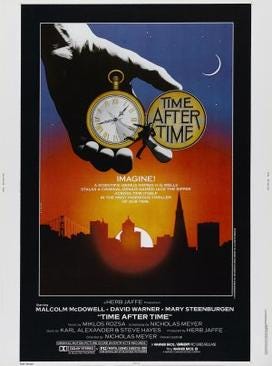
I’m thinking that aside from love, there is no help. In my directing debut, Time After Time, H.G. Wells despairs of humanity, and I have him say, “Every age is the same. It’s only love that makes any of them bearable.”
How did I manage that stunning insight when not yet thirty?
Ask not for whom the barbell falls; it falls for thee.

Many thanks. How weird...
Nick...what an experience! I too have had, in retrospect, moments and experiences that left me wondering why me and not that guy? It's humbling. I will hang onto your pre-thirty insight.