


When I learned how to read I fell in love with 19th century fiction.
I was weaned on The Three Musketeers, The Man in the Iron Mask, and The Count of Monte Cristo, by the prolific Alexander Dumas, (in translation, natch), plus Great Expectations and A Tale of Two Cities by Charles Dickens, and such Boys’ Own under-the-covers-with-a-flashlight matter as The Prisoner of Zenda by the one hit wonder, Anthony Hope, plus The Invisible Man and The Time Machine of H.G. Wells, and of course the Sherlock Holmes stories as well as the historical novels by Holmes’s creator, Sir Arthur Conan Doyle. Oh and what about King Solomon’s Mines, H. Rider Haggard’s bet that he could write a better tale than Robert Louis Stevenson’s Treasure Island? (Haggard came close). And then there’s John Buchan, author of The Thirty-Nine Steps, memorably improved by Alfred Hitchcock in 1935. (Buchan was also Governor General of Canada).
Edgar Allan Poe was yet another youthful fixation - The Balloon Hoax, The Pit and the Pendulum, The Fall of the House of Usher, The Gold Bug – (who can resist an opening line like, “Many years ago I contracted an intimacy with a Mr. William Legrand”? Be honest!)
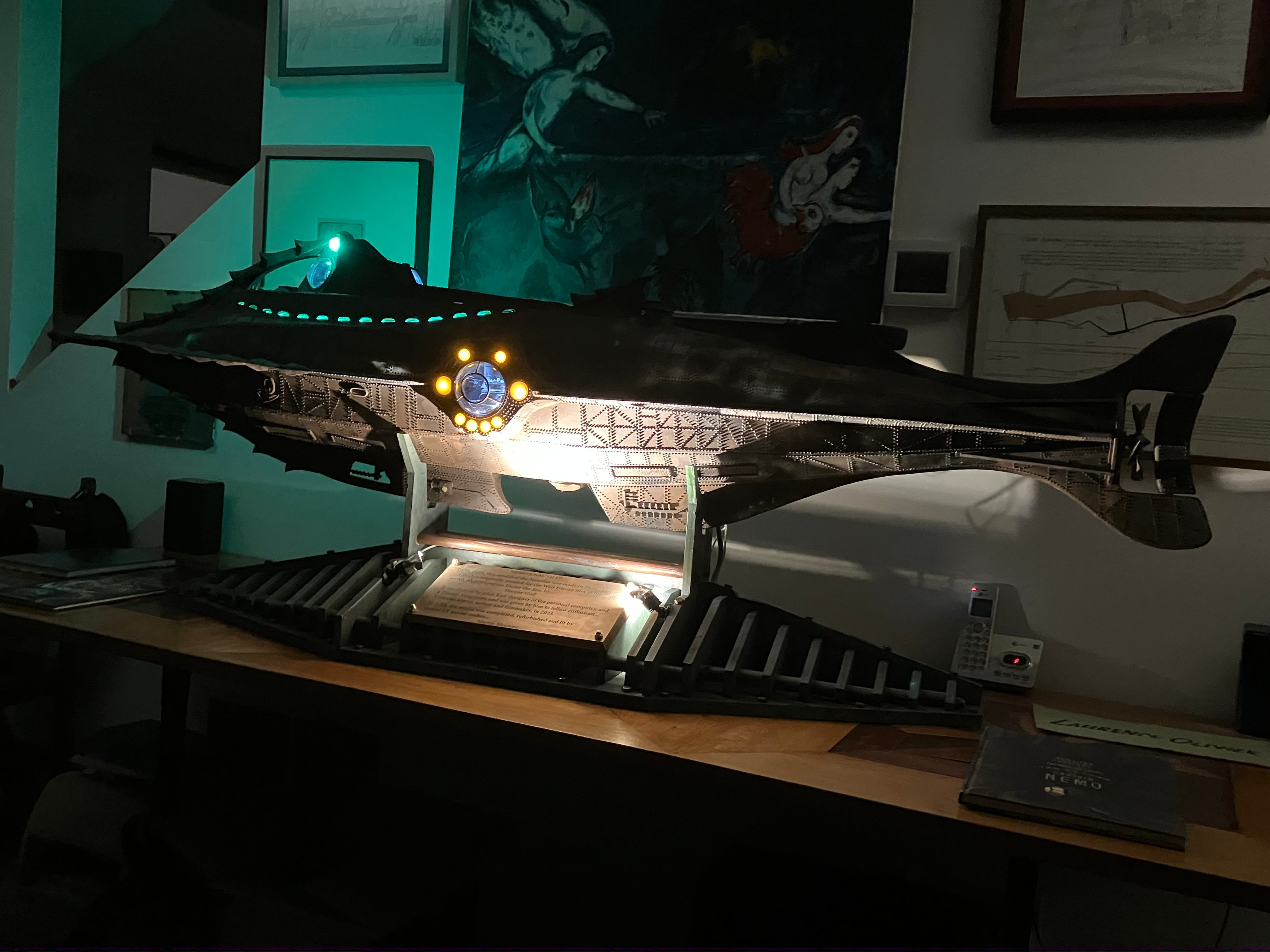
All this stuff was catnip to yours truly, (starting around age 12?) but the Frenchman besides Dumas who really knocked my socks off was Jules Verne. I was introduced to Verne via Walt Disney on his Sunday night television program called – what else? – Disneyland. The telecast was in black and white, but that didn’t stop canny Walt from using Disneyland to promote coming Technicolor Disney product - his feature-length cartoons and nature documentaries, and, in this particular case, Disney’s most expensive, ambitious, and, in the end, greatest film made under his supervision, 20,000 Leagues Under the Sea. (Pax, Fantasia). Even gaping at snippets of the submarine from the forthcoming film on TV filled me (as was doubtless the intention) with feverish anticipation. If you think it’s cool in black and white, folks, wait’ll you see it in color on the big screen!
But unable to wait, I plunged into the book. It is an oversimplification to see Verne as a kind of 19th century Tom Clancy, but Verne had a spellbinding narrative gift along with an imagination always underpinned by solid research. One gets the feeling that Verne started with a What If or Is It Possible-type question and then devised a story to find the answer. Making every connection, how long would it take a man to go around the world? Could it be done in 80 Days? Would life on a submersible be possible? Is it possible for a man to go to the moon? When he set out to answer this question in his two part novel, From Earth to Moon – and a Trip Around It, Verne did the math and knew his spaceship (a cylinder with passengers), would blast off from Cape Canaveral, Florida, shot from a gigantic canon. He knew again that once back in the atmosphere, the thing would parachute down to open sea where the floating cylinder and its occupants would be picked up by ship. Exactly how astronauts in the mid-twentieth century accomplished their original journeys and rescues.
By contrast, Verne’s sci fi “rival”, H.G. Wells, eschewed research and simply dreamt up a substance called Cavorite that cuts off the force of gravity beneath it, and simply floated his passengers upward to the moon! Notwithstanding such nonsense, we don’t dismiss the man who created The Time Machine, The Invisible Man and The War of the Worlds.
Verne’s “extraordinary voyages” didn’t begin – or end – with Captain Nemo and his submarine, Nautilus. Like his moon shot, Verne’s submarine got all the numbers right. America’s first nuclear-powered submarine was christened Nautilus in honor of his imaginary submersible.
Verne also had the world transfixed by the efforts of Englishman Phileas Fogg, accompanied by his loyal French valet, Passepartout, as Fogg wagers his fortune that he can circle the world in 80 Days. Not only was Around the World in 80 Days a bestseller, but a stage version was a hot ticket as well, both later inspiring the intrepid American journalist, Nellie Bly, to attempt beating Fogg’s record, (she did, circumnavigating the Earth in 72 days, six hours and eleven minutes, making time along the way to lunch with M et Mme Verne at the author’s home in Amiens).
Other Verne adventures included Michael Strogoff, (another stage hit), which depicted a chase across Tsarist Russia to thwart an assassination, as well as an airborne riff on 20,000 Leagues Under the Sea, Robur The Conqueror.
It should come as no surprise that 19th century fiction, with its strong narrative drive (and in particular the case of science fiction, with its implicit visual possibilities), should find a welcome home in the movies. As early as 1902, the French filmmaker, Georges Melies, produced a silent fantasy film Le Voyage dans la Lune, clearly inspired by Verne and Wells.
In 1954, with a haunting Captain Nemo portrayed by James Mason, 20,000 Leagues Under the Sea opened the cinematic floodgates. After that came David Niven as Phileas Fogg in Around the World in 80 Days, (1956) - which inspired my own 8mm all kids’ version of the novel and ultimately my choice of career.
Michael Strogoff, with Curt Jurgens and Genevieve Page, was released in 1960, followed by The Mysterious Island (1961), Verne’s own quasi-sequel to 20,000 Leagues. Mysterious Island was augmented by Ray Harryhausen’s special effects, plus a flesh and blood female, the lovely Joan Greenwood, her voice its own special effect). The music was supplied by the legendary Bernard Herrmann, composer of Psycho.
Next came Vincent Price as Robur The Conqueror (titled Master of the World, also 1961). Movie theatres were now choking on Jules Verne adaptations. Verne himself authored two “sequels” to 20,000 Leagues Under the Sea, The Mysterious Island (mentioned above), as well as a novel titled, The Children of Captain Grant. Under its alternate title, In Search of the Castaways, it was filmed by Disney, starring Hayley Mills.
But there was more cinematic Verne to come. In 1965 Phillipe de Broca filmed an obscure Verne novel, The Tribulations of a Chinaman in China, starring Jean Paul Belmondo and Ursula Andress. (In America it was titled Up to His Ears). In 1998 Warren Beatty filmed the same novel as Bullworth. Other versions of Verne’s bullet-proof story are doubtless warming up in the bull pen.
And we’re not counting all the remakes of Verne’s output and what the French call a la manière de – “in the manner of” imitations, of which my favorite has to be Fantastic Voyage, (1966) an idea worthy of both Verne and Wells, in which a miniaturized submarine (with down-sized crew!), are injected into the human body on their own sci-fi Mission Impossible. Maps are anatomy charts: “We can save two minutes by going through the heart!” The best moment is inarguably when Raquel Welch screams, “Help, I’m being attacked by antibodies!” Whoever came up with Miss Welch in that situation, yelling that line, deserves his very own Oscar. It’s a fact that 20th Century Fox has been trying to figure out how to remake Fantastic Voyage ever since.
Verne and Wells between them proved that movies and sci-fi were made for each other. Don’t believe me? Check out Alien, The Martian, Blade Runner, Project Hail Mary, Gravity – the list is endless.. As the gizmos in the special FX toolbox have grown ever more sophisticated, movies – and audiences – can’t get enough of the possibilities.
I know there’s lots of modern science fiction literature, (Ray Bradbury, Isaac Asimov and their descendants), but I confess my predilection leans heavily toward the 19th century variety, probably on account of English prose at that period. The creator of Sherlock Holmes wrote terrific science fiction, The Day The Earth Screamed, The Poison Belt and perhaps most famous of all, The Lost World, a safari/adventure in which dinosaurs are discovered alive and well atop a south American plateau. Doyle, who seemed incapable of writing a boring sentence, created a wonderfully memorable protagonist; who could resist someone named George Edward Challenger?? Professor Challenger definitely gives Indiana Jones a run for his money and The Lost World was certainly the precursor, if not the actual inspiration, for the immortal King Kong as well as Michael Crichton’s own Lost World novel and its subsequent Jurassic Park cinematic spinoffs.
And yet. Notwithstanding the indisputable symbiosis between movies and sci-fi, I conclude by reiterating my preference for language over film. Though I love movies and concede that by this point film can depict anything, in the same breath I wonder if that isn’t in fact the problem. Reading is active; watching is passive. Film is literal, it leaves little room for the imaginative contribution of the viewer. I suspect my fondness for 19th century narrative probably places me in the minority but I’d rather exercise what brain I have imagining the outlandish products of narrative rather than having film spoon feed me the images.
You will doubtless have your own opinions.
For what it's worth, given the kerfuffle over UAP or UFO disclosure, there may be more to the "nonsense" of "cavorite" than is comfortable.
Back in the 1950s the top physicists in the world were working on anti-gravity and convening conferences at universities on it. An independent engineer named T. Townsend Brown had been making progress, and then was recruited by the U.S. Navy and stopped talking. News articles crowed that we were close to achieving it. Then, without ceremony, it stopped, nothing further said. Some think it went "dark," became "classified," because one aspect of such a technology is that it could be turned into a weapon.
In more recent times there have been rumors (some say "leaks") about a Pentagon-funded craft designated "TR3B," a huge triangular thing, that "flies" soundlessly. Former intelligence analyst and whistleblower, Dylan Borland, has described seeing it leave a hangar on a base and fly out over the Atlantic. Others have described similar sightings. My own daughter saw one over Lake Michigan. And there have been persistent accounts of technology aboard the latest U.S. bombers that can reduce the craft's weight by over 80%, giving it far greater range and speed.
And, if that's not enough, several credible scientists (such as Stanford's Gary Nolan) have analyzed metal fragments supposedly from a UFO crash, that display bizarre anti-gravity properties, perhaps a kind of "wave guide". The fragments are a metal sandwich, layers of bismuth and magnesium, I believe, that are individually so thin, there is no known human technology that can duplicate them.
So, cavorite?
I starting reading Jules Verne properly a few years ago, and from a 21st century perspective, it's remarkable how the inventions in his science "fiction" has become a reality. I can imagine how radical and fantastical it must have been to 19th century readers. The works still hold. Do you have a favorite Verne book that you think should be on any reader's (or film lover's) list?